Thursday, 4 March 2021

Accelerated Learning in Literacy

 Accelerated Learning in Literacy Introduction

PfS Programmes for Students

In 2021, I am embarking on a journey in Literacy through the ALL intervention.  This week I had the opportunity to attend a session for teachers who are in their second or third year of running ALL in their schools.

Initially, I wasn't too sure about going to this session and thought I would be better suited to attend the Year 1 session, however, we had our cluster teacher only day which Sheena Cameron and Louise Dempsey and didn't want to miss out on that.  As it turned out, it was really beneficial for me to be able to have discussions and hear about how things were at the different schools that were present.


My Notes~

Relationships and Connections:

Who are you?

Why are you here?

Why do you do what you do?


ALL is not a programme.  Find out about our students and start with them at the centre.  

Teachers talk a lot.  This year, see if you can talk less and get kids doing more.  

Reggie Routman...check out her 10 ways to be a better writer.

Have a look at the professional readings folder. 

Why ALL? 

  1. Lack of pedagogical content knowledge in teachers.  Share and build content knowledge of teachers.  


National Leader Messages 2021 Chris Henderson

Reflections on 2020

  • Relationships with whānau improved.

  • Lockdown exacerbated existing inequities.  

  • Post lockdown, increased focus on integration, key competencies, wellbeing and differentiated teaching.

  • Progress in reading and math but not in writing.


Tiers of intervention...levels thing

National Monitoring Study of Student Achievement

About 80+% of teachers would say their focus is on writing.  The others say reading.  Need to ask ourselves why that is.  Is it us?

  • The more students read, the better readers they became.

  • Reading at home is linked to achievement.

  • If students lack confidence are more likely to be below.

  • Some can’t see the links between stories/books and life.

  • Students report they didn’t have opportunities to share their writing.  If we are going to write, what is our purpose for writing?

  • If you read, greater life expectancy.

What Can We Do More Of, in Literacy?

  • Accurate information that identifies student needs

  • Reading with and to children.  Offers an escape.

  • High-quality dialogue within the classroom.  How do we allow opportunities for high-quality dialogue? How can we ensure children connect? 

  • Telling and retelling stories.

  • A more holistic approach.  Focus on oral language, reading and writing.

  • Read and write different texts.  When writers write, they use elements from a range of text types/formats.  Sometimes we get bogged down with text types.  

  • Involving whānau schooling and in breaks from school.

  • Valuing each child’s identity and what they value.

  • Developing critical literacy skills and collaborative reasoning.  Go back to the Literacy Framework.  

  • High levels of collaboration across teachers with sharing knowledge and resources.

Key Competencies

Are a focus of ALL.  How can we develop all of these together rather than just alone.  
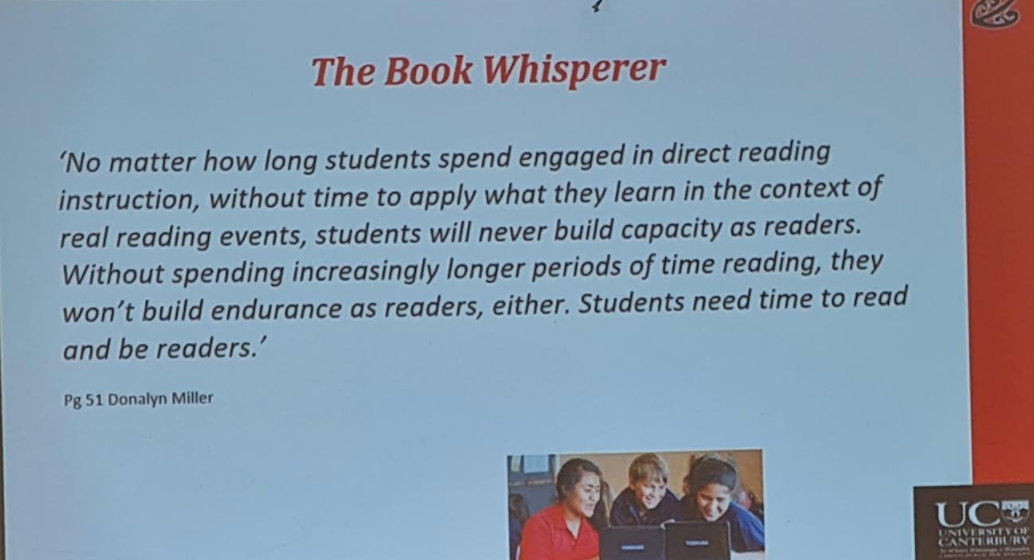
The Book Whisperer  Pg 51 Donalyn Miller  Sounds like a book we should have.  

WHY PfS ALL?

Change from the current state to the desired outcome.  Start at the WHY

  1. Equity-Task:  Read page 6-9 of Sarah Bolton’s Fulbright scholarship paper.  Why do we need equity? Is it fair? Is providing equal education to all students the same as providing an equitable education?  

Encourage students to read like a writer.  What has the author done to keep me interested?  

  1. Focus on a Tiered System-

  2. Improvement of: student learning, Teachers Pedagogical Content Knowledge, Leadership

  3. Lifelong learners.

The How:

Knowledge of learner

Letting students see themselves in the learning


The What:

Selection of students

Knowing the learner beyond the classroom

Connecting with whānau

Valuing prior knowledge student brings to learning

Frontloading

Core and More


Let Adie know about the 19th March Year 1 day


The Tiered System

Tier 1-Majority of children

Tier 2-Need a bit extra-this is where ALL sits.

Tier 3- Few children needing intensive support.

The one shown in the workshop was the other way up/down.

Series of books being released in March and will form part of reading for lower level students.  Decodable texts.  


The Place of Data:

With an intervention we are trying to correct something.  If not all staff are involved in ALL, decisions need to be made about where to put this intervention.  Ideally, the whole school should do this and throw the ALL part out.  This way, it would be an intervention across the school.  If it’s urgent, we need it.  The further through schooling kids are, the more difficult it is to make up that lost time and knowledge.  The target level needs to be the level with the most need.  


An Acceleration Plan:

  • Was known as a Curriculum and Achievement plan.  Used to be committed to writing which is still a good idea.  

  • What is its purpose?

  • Clearly articulates what each of the tiers look like in our school

  • Investigate what interventions we have in the school and the process for identifying which tier students are in.  The ideal is for all teachers to be ALL teachers.

  • Outlines a process when a ‘good’ idea is suggested as an intervention

  • How is Literacy knowledge being built in your school?

Monitoring Progress

A pathway of progress..ask yourself:

  • Where do I want this group to be at and the end of intervention?

  • How will I plan my teaching to get there? You will perform at this level, what will I do as a teacher to help you get there?  A school statement would be good.

  • How often will I monitor the students' progress?

  • When I have a sense that what I am doing is not working, what will I do?

  • Where do I record this?

  • How well can the student te

Teach/Learn/Assess

For the children who are not where they need to be, every second, minute, hour...is important.  We need to move them on.  


Read Developing Assessment Capable Learners.  


What will happen next for my school?


Another Why of PfS ALL:

Improvement of:

  • Student achievement

  • Teacher Pedagogical Content KNowledge PCK

  • Leadership

With the budget provided.  Create a plan for when to take the release and what I will do with the budget.  Use this in the first half of the year due to June changeover.  

Julia Gillard podcast about inequity.  Important qualities of leadership:  1) self-doubt 2) curiosity 3) preparedness to ask questions.  4) developing a high performing team.


UC edPLUS is closed and most are working with Learning Solutions.


Ideas:

  • The novel study...kids choose books.  In guided reading, the teacher didn’t need to talk too much.  

  • Reading for pleasure.

  • The pathway of progress is in the folder.  Literacy learning progressions are also in there and could use a template as an assess and plan document.  

  • Core and More...ideas from the group:  All takes place in place of something like Steps/Word Study.  Tuahiwi-play and eat time.  While kids were eating, they would do this together.  Think of what teacher interaction kids get now, and how can you improve that.  SSR time.  TA to work with other students while the class teacher is with them.  Don’t be talked into letting someone else do it.


Acceleration vs remediation-Suzie Pepper Rollins

High Impact Teaching strategies

Notice, recognise, respond

Enact your plan

Include the student in planning.


Knowledge of learner and literacy skills.  See, say do...modelling book

Exemplars

Choice, context, Pathway, the reason for doing what we do.

If such and such can just…

Connection to family.


I do, we do, we do, you do. Cups and ARMS and CUPS.  Creating a school newspaper/flier.  Digital newspaper.


Frontloading is the number one successful strategy.  Some front load prior to the class lesson.  Co-teacher with the class and teacher focus with this group.  

The day before, do something about the following day’s lesson.


Reporting required. Initial data 26 march and interim on 11 June.  BOT for ALL intervention.  This form is in the shared folder.


My Next Steps:

Select the group of students with who I will work on this intervention.

Make contact with whānau to explain the plan and intervention.

Start creating opportunities to spend time getting to know more about the students.


Reading with Sheena Cameron and Louise Dempsey

Sheena Cameron and Louise Dempsey March 2021

Aims:  
To review the modelled, shared and guided independent reading approaches.
To share practical ideas for planning a realistic and manageable reading programme.
 
Explicit teaching of reading is important for all levels.  We need to know exactly what our kids need and teaching to these needs.  Student agency can take place as long as we know exactly where our teaching is happening throughout the day.  
Mini-lessons.  Skills can overlap as they support learning in reading and writing.

Reasons For Reading:
  • Reading for pleasure.
  • Reading to support writing.
  • Reading to learn...reading across the curriculum.  
Q. Do I have enough time in my day to ensure children can read for pleasure?  

Development of Reading Skills and Strategies
Developing a love of reading
Developing oral language and vocabulary.
Getting ready for reading...Learning to read...Developing independence as a reader...Becoming a proficient reader.

Early years...school entry...junior primary years...middle years...senior primary years.

Reading Levels, reader characteristics and text characteristics.
The Reading Process...Chapter Two of The Reading Book

Critical thinking can happen when we make time to talk.  Conversation Cards form the Oral Language Book support listening, talking and being able to elaborate on ideas. 
One card we tried was using the proverb, No matter how many times you wash a goat, it will still smell like a goat.  Ethiopia
Prompt:  What is the author trying to tell us?

Using all of the visual language information available to us.
All three decoding skills are important and can be taught in mini-lessons.
A balanced programme will include all of these.

Important for kids to know about word parts.  

Website:  The Literacy Place
Rhyme lists help support reading development.  HIgh-frequency word development.  Use a whiteboard to write as many high-frequency words and share.  

Self-Monitoring Strategies
Can pick and choose your own fix-up strategies that suit your learners.   

A Balanced Reading Programme

Model and teach a skill on a Monday and revisit this in instructional groups.  Practice skills and strategies with a focus on the main skill.  Four-day timetable with the Friday being about finishing work, teaching a certain type of od activity and developing a joy for reading.  
Reading to kids and reading parts too, gives kids more confidence and can be more engaging.  Reading aloud to kids can be within different approaches.  
Why we read to students:  
Modelling how to read and respond to texts.
Enjoyment.
Relationships and connections.  
Broadening experiences and insights.
New vocabulary.
Variety of contexts.  
Connections.
Fostering a love of reading.
Exposure to different text structures, organisation and language features.  
Extend general knowledge and understanding of the world.
What Can We Read?
Love the idea of reading stories from the cultures that our kids are from.  Also need to read more of the writing students create.  

Develop more of a culture where we read together a lot.  The Literacy Place
Have a look here for links to some great online reading that we can share in the class.  

Shared Reading
If we include shared reading, what we learn there can be included in guided reading.  A shared reading programme will help your reading programme become better.  
Texts we can use:
Big books, fiction and non-fiction
Poems
Songs
Picture Books (projected)
Sections from novels (projected)
Articles
Visual texta, comics, graphic novels, videos with texts)

Variety is needed.
KidsNews is a cool site and is organised into levels.  Literacy Online has a range of reading material with listening files.  

Catering to a wide range of needs.  Quality over quantity.  For shared reading, the same book throughout the week.  Repeated reading is really valuable.  The first time is on a superficial level and throughout the week going deeper.  Read shared books at a level that is higher than the level of the students.  
Focus 1: Book Introduction
Focus 2: Zooming In-Looking at words, sentences and decoding.
Focus 3: Zooming Out-Comprehension and thinking critically about texts.

Vocabulary
From the shared text, select words that might be challenging for the kids.  Word on a card in groups.  Decode the word, talk about phonics, discuss their meaning, predict what the text may be about.  
PHONICS
CHUNKING
ANALOGY 
This activity can be used in shared reading but also in guided reading.  Anything available in shared reading, also enable students to access this in guided reading.  
Using whiteboards during reading lessons supports their writing.  Walk and talk to share and change/add to your ideas. 
Introduce Fix-Up strategies.  
Tick and check 
Word building activities and looking at the text in more detail. 

Resources in Oral Language Book can help discussions around comprehension. Using thought bubbles to talk about what characters might be thinking.  Use it in your big book so you can model it to students.  Could laminate the thought bubbles and children could write what the thoughts might be.  Can also use a Question.  

Drama
There are ten drama cards on Page 160.  Act out the story.  Shows retelling and helps kids to remember the story.  
Hot seating:  One student takes on the role of a character and students ask questions to the character.  Asking questions of the student in role helps them infer.  
Dice have been created to help with asking questions.  
Freeze frame-Create a scene, one student goes around and asks each character what they are thinking.  great inferring actib=viyt and looking really deeply into the text. 

Teacher talk less, kids talk more.  

Guided Reading
Intro
Components of a guided reading lesson
Opportunities for talk
10-20 minutes for each group.
The teacher guides a group
Other students engage in reading activities (collaborative or independent)
Guided reading shouldn't be about getting through the book or reading a certain number.  Aim for quality over quantity.
Planning and Assessing Progress
Flexible approach to grouping, can some kids go into another group if theirs is a small group?  Keep the same learning goal and work on that across a range of books/texts.
Link shared, guided and independent.
Generic follow up activities.  Don't create a set of questions to answer about the book.  Maybe use a question dice.  
(See Page 124 for levelled goals for reading, cracking the code, fluency and comprehension).  

Modelling Books
Not really used to Magenta/red groups as they can't read what you write and things are quite quick with them.  
How can you use your modelling book?  
Tricky Words-Record tricky words from the text.  
record questions for the guided session.  Can write questions and children write answers on post it's as shows evidence of work towards meeting learning goals.  
Record teaching point and notes about tricky bits.
CUse the modelling book for a 'warm up' or 'follow up' activity.  Graphic organisers...collect examples of student work.
Keep a record of progress.
One goal at the front of the book.  
 Guided Reading
1) Book introduction-teacher hold the book through this part.  Make sure kids have a really good understanding of the book before reading it.
 2) Lesson focus-Alphabet cards, word cards at level, high-frequency words hunt...can you find...?  Looking at where does the sentence start, the text spotters to isolate words.
3)  Independent reading (guided by the teacher) If a longer text, chunk it up.  Children read and come back together and talk about it.  Listen in and guide and support.  Students read in a quiet voice OR read silently.  Tap and read...you tap child and they read aloud so you can hear what is happening while they read. 
DON'T-
Read in unison as this becomes shared reading.  Limits how we can self-monitor and check.  
Round robin read.  Interrupts meaning for kids and outs them on the spot.  Get children to read quietly by themselves.  Short and sharp and then they get to come back together.  

 4) Wrap up-Discuss comprehension, review tricky sections, review learning focus, introduce the post-reading activity.  

Aim for kids to talk more than the teacher.

Independent Activities
Don't plan too many activities.
Mixed ability groups can work.
Consider letting students move between activities when they are ready.  
Provide some choice and the opportunity to self manage using Must Dos and can Dos.
Limit worksheets because you have to find them and make them specific to the group you are working with.  Need explaining, monitoring and then marked.  
Plan generic activities that can be used several times in different contexts.  
Story maps, Venn diagrams, same and different Venn diagrams, 
A cool activity was the one using the dice and children look for certain details in the text.  
Reading Activity Modelling Book
Frayer chart for looking at words, definitions, uses and a picture.  
Choice systems, book clubs, See Reciprial Reading slide from the site.  Reader's Theatre
Independent Reading
Be more active.  get up and go and talk with kids about what they are reading.  
Set clear expectations, show a list of with stamina and without stamina.  
Supporting kids to select and read appropriate reading material.  
Set personal reading goals, professional reading, novel.  Must read the books we are getting students to read.  Reading challenges.  Record selves reading and then share.  Reading Thoughts activity.

For me, this session has really given me clarity and more of an idea of how to structure and run my Literacy class.  I also feel a little overwhelmed with the levels and abilities of the children I am working with and struggle to see how I can possibly meet their needs.
Next steps:  Create modelling books for reading groups.  Include activities of a more creative nature for children to be doing while they are not working with me.  


Tuesday, 27 October 2020

Manaiakalani Magic

 Secrets To Success

Today we had a session as a staff with Kelsey.  This was about reflecting on how far we have come and in the six years of being part of the Manaiakalani Outreach Programme.  

One of the tasks we did was to work in groups and create a digital learning tool under a set criterion.  Our audience was a new teacher and we needed to share one of the gems we have found and used throughout our Learn Create Share work.


My group, Kathleen, Brooke and Rose who are first-year students from the University of Canterbury, opted to create characters using Voki and to have them speak out our information.  For most people in the group, this was a new tool so it was great to be able to share that.  We then used Screencastify to record the Voki and inserted them into a Google Slide.  We chose slides so we could add more information later. 

Our 'gem' that we shared was individual student blogs.  Check out our creation:


I really enjoyed this activity and loved that it was a learning experience for our group. It was also really cool that our group members all had roles that we slipped into very easily.  It was a good opportunity to share tools that I have found beneficial and to also share why individual blogs are a great tool.

Wednesday, 30 September 2020

Harakeke

 Harakeke Staff Development


• Practise and develop the use of te reo and tikanga Māori. 

We are very lucky to have harakeke growing in our grounds and unfortunately they have been neglected through the years.  Rather than let them continue to be left and overgrown and to be able utilise this resource, I approached our Resource Teacher For Māori, Christine Brown for help.  

She came to school and took a staff session which was open to all staff.  She took us through the tikanga and explained why harakeke is such a precious part of our heritage and culture.  We spent some time with our plants and had the opportunity to cut it, making sure we followed the correct protocol.  We then went back indoors and worked in pairs to create a taka.

This session was so valuable for all of us individually and as a school.  Our next step is to cut off dead parts and tidy the area around where our harakeke grow.  Some classes have already used harakeke with children and our senior part of the school plan to use harakeke as the base for our technology unit in term four.


Teaching as Inquiry 2020

Extended Learning Conversations With Students and Whānau 

• Specifically support the educational aspirations for Māori learners, taking shared responsibility for these learners to achieve educational success as Māori. 

For my Teaching as Inquiry in 2020, I chose to look specifically at the Māori students within our senior learning space and see if having extended learning conversations with students and whānau, showed some positive progress in Reading.

Although Covid 19 threw some challenges, I was still able to engage in learning conversations with students and some whānau, particularly those in my Literacy class.

The slide below shows this journey:


My next step is to share more Reading work through Hero regularly and not just at the end of the term.

Thursday, 16 July 2020

Standout Assessment 2020

Standout Assessment

In 2019, I attended a workshop for middle leaders and we looked at our leadership styles and the ways we could work to our strengths.  Part of this was doing the Standout Assessment which I have just recently read again with the intention of using the information to help me develop as a middle leader.  
I think it important for me to first be better at identifying and acknowledging my strengths while also using what I know about myself to be more effective in my role.
Here is a brief overview of the assessment information.
My next step with this is to make sure I read through the things I can do to take my performance to the next level.

Sharing Progress

Combined Basic Facts Assessment

• Communicate clear and accurate assessment for learning and achievement information.

As part of my Numeracy programme and in order to share with students about their progress as a group, we did a Combined Basic Facts Assessment for addition and subtraction.  
I created a slide showing the amount of progress we had made in our number knowledge from the beginning of the year to partway through term two.
I removed names for this exercise as I wanted to highlight the fact that as a group, we had made some great progress.
Students loved seeing this slide and were proud of the improvements we had made as a class.


Tuesday, 14 July 2020

Self Love

Kerwin Rae Tells It

I came across this clip as I have with many others that I think are worthy of sharing and resonate with me.  More often than not, I don't take the time to post these clips to my blog.  
This clip has links to things we spoke about and looked into during our Springboard Trust Highly Effective Leadership Teams sessions.  

The main points:
  • Sometimes we act in the way we think others think we should be.
  • If we are smart, we want to continually improve.
  • How do I contribute and help others while I am being the best that I can?
  • Be a winning woman by being yourself.
  • Self-love is knowing our strengths and weaknesses, delegate the weaknesses.  Accepting yourself the way you are.  You don't need other people's approval.

Language warning here...

Friday, 10 July 2020

Sharing Learning Progress

Number Knowledge 


• Communicate clear and accurate assessment for learning and achievement information.

I always find the middle of the year and end of term two and exciting one as far as student progress and next steps go.  Students will have had half a year to get settled and into the swing of things in different areas of learning.  
Often I wonder as we are going along about how much they have actually achieved and how they are doing in their learning.  With Covid-19 having a part to play in the disruption of our first half of the year, I was worried about what had been maintained and if students had lost or forgotten some of what we had started.

Combined Basic Facts Assessment
One area of concern was Numeracy.  My Numeracy group had just started and I saw significant gaps in number knowledge that I felt needed to be tackled.  
In term one, we did a combined basic facts assessment.  I shared the specific areas that students needed to work on and in class as well as using this as a sample for sharing to whānau through Hero. 
I provided learning opportunities for students to work on then in term two, we completed the assessment again.  Upon marking these, students were keen to see their scores and to see which areas they had improved on and still need to focus on. 

This provided students with clear and specific skills that they could work on and monitor progress.  

iKan Number Knowledge Assessment
Another form of assessment we use is iKan to determine number knowledge learning.  In the senior school, we do this each term.  Often, this is not a well-favoured assessment as many children struggle with the speed and the level of difficulty once the assessment reaches Stage 6.  
In term one, my Numeracy group assessment showed significant areas of need.  Once these were marked, I shared the scores with students by giving them their tests back.  We then spent some time looking at the questions they got wrong so they could determine where they went wrong.  
Fractions was an obvious area of weakness so we worked on this in the first half of the year and had a focus on basic facts and times tables.  
In term two when we returned after the lockdown, we completed the iKan assessment again, marked it and students compared their tests to term one.  It was great to see that students were looking closely at their results and comparing to term one.  
Our next step is to continue to develop specific knowledge areas and complete the iKan assessment each term.  I aim to have a clear picture for parents that students can share and hope to engage more learning from home.

Virtual Comments

Keeping up the Positives

• Actively contribute, and work collegially, in the pursuit of improving my own and organisational practice, showing leadership, particularly in areas of responsibility.
During the time in lockdown and distance learning, I tried to think of ways that I could keep some of our school initiatives to support wellbeing and connectedness being maintained.  
To support our learners, give specific feedback and positive reinforcement, I created Virtual Fish Tickets.  These were used in a similar way that we do at school but looked way better because I could use a gif to make them more appealing to students.  I shared the template with staff and it was great to see that these were also being used and celebrated by most teachers.
The thing I liked about these was that you could personalise the Bitmoji and be specific about what students were getting them for.  You could also highlight the value they had shown.  
During the lockdown, I wrote and gave out about 250 of these virtual fish tickets.  
Feedback from students was positive and on our return to school, some could be heard in conversations about how many they had received.


For Staff
As a staff, we have a wall in the staffroom with named kete that we use to keep up the positives, give compliments, show thanks and aim to make someone's day.  During the lockdown, I created Google Drawings for different staff members and shared them with them.