This blog aims to record and reflect on ways I demonstrate knowledge and application of Our Code, Our Standards as outlined by the New Zealand Education Council. This blog was created in 2018 and the intention is for it to continue to be used in years to follow.
To start - We had a sharing session about our mahi kāika and how things have been going over the last few weeks.
My to do: Meet with my mentor, complete homework tasks from Day #1. Do ground rules for talk. Add links to the Mahi Tracker.
Dorothy Burt's Kōrero: Wider Picture of Manaiakalani
The RPI is grounded within the wider picture of Manaiakalani. This has come as a response from principals, wanting learning for teachers.
One of Dorothy's memorable teachers was one who allowed students to choose books for their National Library class collections.
Knowing our learners is not a new concept.
Literacy Cycles -
Teachers looked at how many opportunities students had to read. Multiple opportunities to read through each part of Learn, Create, Share. (Have a look at Kōrero Pt England podcasts).
Good idea: Students do reviews of New Zealand books with one student being the podcast DJ.
Shows literacy inclusion throughout the learning process.
share.manaiakalni.org Recommended for students to access as part of their reading learning. Very important part of a reading task board or tumble. The more students read of other student learning, the more achievement and progress.
Chalk and Talk - Assessment 101
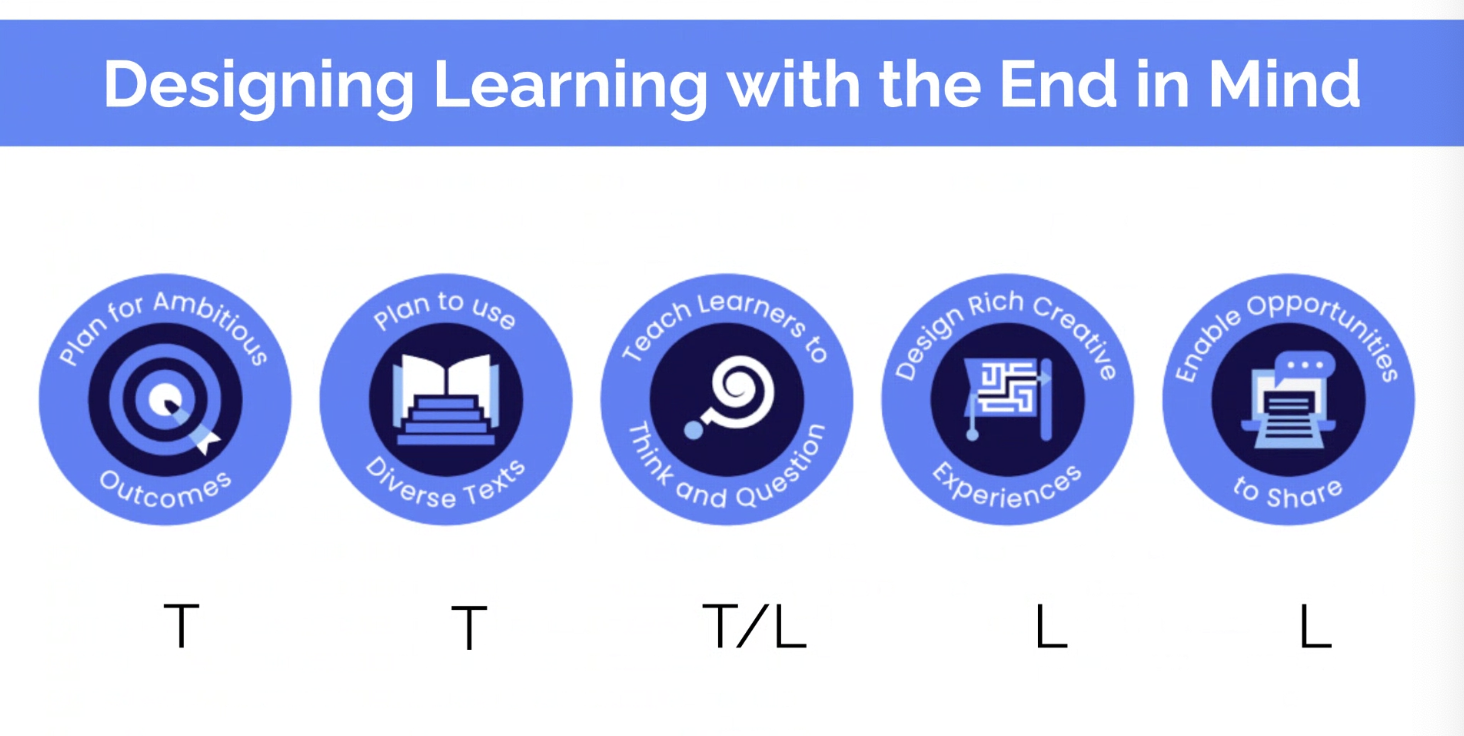
Whatever type of assessment we use, we need to actually use it or it's a waste of time. Planning for ambitious outcomes.
WHY?
Anything over .4 is exceptional. All of these, have a significant impact on reading achievement results.
Formative assessment feeds directly into our teaching and learning. Summative is beginning, mid and end of year for tracking progress. Standardised so gives us a good indicator of how we are doing as teachers.
BreakOut Activity
We shared about what types of assessment we use for Reading. What do we do and how do we use it?
Two main documents: New Zealand Curriculum and The Literacy Learning Progressions.
If the things on the left are being done, the things on the right will happen.
The Teacher Work Book: Don't freak out!!! Today we are focusing on the first tab. Thoughts: Hero can track really well if it is being used to its full capability. PAT Next Steps: Populate Google Sheet with this information.
My Workbook -
Task: Treasure Hunt of a Workbook -
1) Reading age 9 - 10 years 2) 11/24 are below 3) Damon is working at Level 2 4) Novels and chapter books - Got this wrong. 5)talk about the purpose of the text (entertain, persuade, inform). 6) - Infer meaning from punctuation (e.g. exclamation); - inferring meaning from personification;
Tracking Reader Profiles
Knowing our learners as readers.
We went through how to copy and paste results from the learner survey to our workbooks.
For me, complete the reader profile survey, but in the meantime, use data from Mel's survey that she has shared. Choose a student selected text to read by myself.
We looked at how to sort survey questions to help gather information.
My Group to Focus On:
Common Personal Reading Goal: 'Read bigger and longer words'.
One Book: Goosebumps
A cool tip for Google Sheets is how add drop down boxes in columns, which will be good for grouping kids. I like it.
Book Share: Porangi Boy by Shilo King
Good to have a mirror book which is where they see themselves reflected.
Discuss survey findings with learners, particularly the part about reading for enjoyment.
Reading Challenges Task Boards. Giving options and choices.
Using Our PAT Data:
We can pull all of our data into our workbook. Use scale score as stanines don't show you shift.
Ambitious learning outcomes for students.
Look at Ed Potential data. Grey line is the norm. Black is average.
Use Item Report to identify gaps.
I identified that Retrieval is a gap.
Check out the teacher workbook. This is an example of an individual report from my class.
This is so cool and great to how different functions work and how to interpret. It is important to share the information with ākonga. With students, what derailed us and what skills did we need to see success and understanding?
Task Boards:
The boxes in red identify the activities that support the learning outcomes. The response to Text piece is an independent task and shows evidence of meeting the learning outcomes.
To Check Out: ARBS
User name - arb
Password - guide
I think my life has just changed although I need to look at how to share with students and ensure that I get results. First step would be to set up a teacher account.
Developing Assessment Capable Learners Using Learning Intentions and Success Criteria
Stick to one of these as it doesn't really matter which one.
You can use the learning progressions, and adjust them in your workbook. Hero also has this function.
Don't write learning intentions like this...
They are too broad.
Coming back to this.
Ensure that the success criteria relates to the learning intentions. The learning task board also contains the learning intentions and success criteria.
Activity - Organise statements into the right category.
Ask students what they learned. Over time, students become part of the creation of success criteria.
Task: Add learning intentions to group planning page.
Pulling it All Together
Assessment 101
Keeping track of learning
Assessment tools
Learning intentions and success criteria
Start what is manageable. Repetition embeds learning.
If students are adding links to the hand in sheet, get them to use their initials. Rows can be assigned and locked to one learner so ākonga can't edit anybody else's. Good tip for protecting sheets.
My Reflection of Today
Today I made my notes directly onto my blog instead of a doc. I saved it as I went along. I just found this easier than last time when I recorded notes onto a doc.
Pinning the agenda helped me keep track of all of the slides.
I like the task board and will add a template to the current slides that I use for my groups.
I am pretty glad that I have seen and started using the workbook, even though I haven't used it to its full capability. I think if it was completely new to me, I may have felt quite lost.
Some of the data that is currently in my workbook came from Mel's survey. I need to decided if it's a good idea to conduct the survey again with my learners.
Looking at the PAT data and what NZCER Assist has within its platform, was fantastic. I didn't realise that the scale score showed movement so that's something new that I will start focusing on, rather than the stanine, which is what I have been focused on.
I was also very interested in ARBS as I haven't used this before. I am quite keen to try this with one of my groups to see how it goes and what information I can gather. I really liked how the texts were available through this site.
Reading in foundational aspiration of Manaiakalani programme.
Reading is essential. If we want children to have equity, they need to be confident readers.
Poor reading ability has a detrimental effect on life and makes school difficult. The ability to read is a social justice issue and is associated with disadvantage. Some kids have to make more than one year's progress each year. Acceleration is hard work. Teachers are working hard and smart to meet these needs.
Ākonga also have to work harder.
Railway line: One side is effective teaching, and the other is the digital world. To harness the potential, we need both sides of the track.
Framework - Describes the Manaiakalani Programme and the relationship with schools in the partnership.
The Why - Three consecutive years or more of being in a class for three years or more, young people get the rewards.
Reading requires intensive competence in teachers.
National Relevance - Student feedback across the country says they have been doing less reading.
What characterises a good reader?
-Understanding of what is read.
-Being able to interpret information
-Learn from what is read
-Enjoyment for reading
-Make meaning
-Reading mileage.
-Word knowledge and vocabulary
-Good readers participate
-Good readers read widely. Show better academic outcomes.
Reading Role Model - Kids Tell Us Why We Read.
For me: Share more favourite books and delve into what we share as a class, what kids have read and the recommendations ākonga might have.
Reading survey - Libby for online reading. Needs a library card barcode. Only 36% of schools have libraries.
Books I might read with the class: David Walliams Mr Stink maybe.
Pillars of Practice
Reading to Learn
Cover a range of genres, hook kids in, and use a range of relevant contexts. Comprehension strategies - skills that need to be learned. Reading is everywhere. Reading and writing are connected. A library in a school shows we value reading. Can create a hub-type community in the library space. Reading is Core to Learning video from Richard.
The New Zealand Curriculum -
How can guided reading capitalise on local and current contexts?
Little trauma becomes big trauma. Can impact attendance, engagement and learning. Can avoid learning tasks to avoid the shame of not being at a level that is expected.
LETRS Training and MSL - Will be really good professional development. Catch Up Readers...good for older, struggling readers.
Thinking about our school:
At least 60% of tamariki require code based, systematic and explicit instruction.
Spelling is needed for proficient writing.
Vocabulary Check Activity:
We had word cards and meanings to match up.
Focus on Phonemic Awareness. Liz Kane Facebook Page is a good one to follow.
Some things are not for discovery, some things just need to be taught. Error-correct as we go.
Syntax and Grammar programme. Kids writing definitions is not learning vocabulary. They need to engage and interact with it.
Engagement Norms - Turn and Talk, Cold call, non-volunteers, whiteboards are good for checkins and can be seen by the teacher, books, track with me, read with me.
For me...cold call system.
Video: An expert minute with Dr Anita Archer, who created I do, we do, you do.
Ponderings:
Struggling crew...I do, we do, you do with teaching letter sounds.
Students need three kinds of practice:
Deliberate
Spaced
???
Instruction needs to be interactive so students are engaged.
WATCH AGAIN AND CHECK THAT LIST
Interactive
One of the main things that came out was the guided practice, rove and respond. Kids with dyslexia and who are struggling need loads of we do, we do, we do.
Letter sounds every day and quickly.
The Not So Simple View of Writing
Handwriting needs to be fluent and legible. Typing also needs to be automated. Practice makes permanent. What they have been doing is mapped in their brain.
The goal is proficient writing.
'The small steps really matter, and they often look different to the end goal'. Daisy Christodoulou.
Smalls steps for writing: Spelling, handwriting, teaching sentences, graphic organisers to plan.
Writers Toolbox is a good resource. Take the time to break things down.
The Code: Part of my plan for teaching writing.
How many sounds in the English language? 44
How many ways to spell those sounds? 250...around 150 common ways.
Orthographic Mapping:
Gluing spelling to pronunciation and meaning. Children with stronger oral language are going to perform better as when they come to words they have in their spoken language, there is something to glue it to.
What we can write, we can read!
The writing part takes a lot of practice.
The Four Part Processing Model for Word Recognition
We are judged by our spelling, whether we like it or not.
Teach the meaning and practice. Most of our vocabulary is learned through reading.
My next step: We are learning homophones next week.
Most successful teachers spend time:
Guided practice
asking questions
checking for errors
A Lesson - List 13 -ed
Daily Review
If struggling with vowels, give an anchor or some kind of support.
Spelling voice: heart word people reading voice people spelling voice: pee op ple
Reviewing sounds: Which letters make the sound ay in play?
ay - play
ai - paint
tch - latch
ou - cloud
ow - clown
ph - phone
people
Today I am teaching you...suffix -ed. t / d / id. Use fingers for sounds. Read through a list of words together.
t=jumped, locked, skipped
d=waved, stayed
id=hunted, shouted
Make a chart. Read words together.
Write in books:
locked - sound and write, underline the ed.
played -
shouted -
jumped - underline suffix ed
growled -
waited -
Do about 8-12 words. Scaffold first ones. Pens down and read through the words.
Listen, say to buddy and write it down.
The house is locked.
They planned a trip to the lake.
He was excited to see the game.
Get really strict on capital letters and punctuation. No capitals unless they are meant to. Don't let them leave until they punctuate. Kids need to do that work in the training plan for writing.
With dictation, the sentence needs to be held in their head before writing.
For whole class teaching, differentiate at sentence level. Get in as much dictation as we can.
Review, explicitly teach, practice and apply. Book to get: The Dictation.
Sound Check book
Use the sheet in here to reinforce the learning of the sounds and also suffix -ed.
Check out Page 3 Introduction - Read it
Word checks are a snap shot. When making judgements, consider student writing books in order to make a call about spelling. If its wrong, its wrong. Use Sound check activities from books 1 and 2.
Phonemic awareness assessment only for struggling readers. Used only after teaching for ten weeks. Not for students who can read.
Dibbles screening tool - 1 minute per student, 3 minutes for whole class.
Wasting time doing Probes.
Data sheet is on Liz Kane website. Takes ages to put the data in.
Kids need to be reading all the time and every day.
Cognitive Load
Human brain can only process a small amount of new information.
Working memory - what we use to learn new ideas and manipulate information. Limit of 4-7.
Things in our environment can take up space in our working memory. Being uncomfortable etc...lots of things creep in and take over working memory. We want to automate spelling and handwriting so we can retrieve it and it doesn't take up much room.
Make sure we are not overwhelming kids as we teach. Bite sizepieces and loads of review.
BANCH
ABC NETFLIX HBO CNN TVNZ FOX
The more mastered something is, the less working memory it takes.
Goal: Optimise intrinsic load.
Extraneous load: tangents, outside noise,
Implications:
Be clear about what you want to students to learn.
Be direct and explicit - cut iut redundant information.
Give worked examples - modelling
Daily review and retrieval practice
Predictable, repeatable routines with low variance - Use simple language and consistency across the school.
Managing cognitive load - Daily review, explicit teaching, practice and apply.
If it's worth teaching, it's worth reviewing.
Handwriting - Transcription
Get kids to write the alphabet.
If kids can't write the letters, writing will be a real problem. Output is impacted by transcription issues.
Explicit teaching - "I am going to teach you the long spelling for /j/"
The sound is /j/, the spelling is dge. One syllable and straight after a short vowel.
dge - fudge,
Create a T Chart to check one syllable and short vowel. Cringe and huge...with older kids, use non-examples too.
Write: dge. dge. dge. dge. dge. Write the pattern 5x across the page saying 'dge' as you write.
Student practice:
List 40 CVC doubling rule. CVC and Vowel Suffix
Base Word. Suffix. New.
C goes with a.o and u and k goes with the other two.
The Jobs of Silent E
Make the vowel long - bit>bite
Makes c and G soft - dance, hinge
Keeps I U and V from being the last letter - pie
Shows the word ism't a plural - lapse
Adds a vowle to c+le syllables
Makes th voiced
Clarifies meaning
Morphology - study of morphemes
Morphemes 0 the smallest unt of meaning in a word.
Bound and unbound morphemes
Bound - in+struct+ion Struct cannot stand alone,
un+help+ful. Hearing about prefixes can start early.
With older kids...Phoneme / Morpheme Analysis.
Morphology chains:
Basic Word Matrix:
Jason Wade Education: the sensible spelling system.
Catch Up to Keep Up (Insert those three photos).
Target students get core and more.
Intervention RTI: response to Intervention. RTI is a process that aims to provide targeted instruction for students that need it most. (Add tier 1 - 3 pic).
Scripts
List 20
I am going to teach you a spelling for the sound /ē/. The sound is e the spelling is ee.
Pronunciation, sound, meaning.
Review homophones regularly. Will be recommended to teach a homophone a week and add in your review.
Today I am teaching you the sound a spelling for the sound ea. The sound is e the spelling is e a.
The sound is...
The spelling is...
What is the sound?
What is the spelling?
Say...sounds...'I hear ur and I spell it u r'.
List 28 R controlled Vowels
I am going to teach you a spelling for the sound er. The sound is er the spelling is e r. Say herb, sounds? I hear er and I spell it. What's the sound we are learning? How do we spell it?
Today I'm teaching you a spelling for the sound ur. The spelling is u r.
I am going to teach you the prefix re...it means, do again? What does it mean?
List 60
The sound is /u/ the spelling is ou and the sound is...
I am going to teach you the spelling for the sound /o/ after a 'w'.
Watch, I hear qu has two sounds k & w...so quad has the W effect so it's an a.
Heart Words - High frequency words that may have a part that may be irregular. Need to be able to recognise some of the sounds. Some, you just need to teach the spelling. Review through a flash card or on the screen. Be creative with ways that you can get kids to spell these words. Spelling voice is helpful and makes it easy.
Once you have this learning, you need to give yourself a year to practice. Take time. One group or whole class. One list a week...two parts=two weeks. Timetable pic, works for the whole class teaching.
Reflecting on our own leadership helps us to become better leaders.
What do you believe leadership is?
Strong relationships
Being approachable
Trusted
Supportive
Best interests of all
Effective communication
Being able to see the big picture and the details
Who has influenced you as a leader?
Greer Doidge - One of my first mentor teachers when I was a beginning teacher. Knew her stuff, great fun and always keen on a laugh but also highly professional. Gave me some of the best feedback and feed forward that I have had in my career.
What aspects of educational leadership do you think are the most important?
For me, trust is a big one at the moment. Honesty in being able to question things or share things and kow that it is a safe space. I think in educational leadership, you need to have the tamariki at the centre of all that you do. Sift through what is not important. See the learner as a developing person not just the kid in your class/school for however long.
With your own situation in mind. Look below at the qualities of middle leadership
Select and write down 4 things that you do well and often as a middle leader and think of three that you would like to give more thought to.
Cultural Responsive Practice
What is the aim of culturally responsive practice?
Patara, 2012 P50
Relationships are key.
Purpose: Affirm or challenge what we do at school.
Watched video of Brigham Riwai-Couch. Was hard watching the first time and is emotional watching it again...so I
10 Ways to Teach Me
1) Have no other goal other than to teach me.
2) Have high expectations and believe I can and will achieve.
3) Don't underestimate the importance of pronouncing Māori words correctly.
4) Show whakawhanaungatanga - Relationships.
5) Honour the Treaty as the principles apply to education.
6) Don't kill my wairua, belittle me or put me down.
7) Design and deliver lessons to engage me.
8) Use our culture and identity as an asset in the classroom.
9) Know that achieve is good, merit is better, excellence should be the target.
It has been a long time since we held a Māori Whānau Hui so it is great to be doing one this year. I am really looking forward to meeting with some of our whānau and hearing about what they want from us and how we can work together to get the best possible outcomes for our Māori students.