Tuesday, 5 March 2024

Middle Leaders 2024

 Supplementary Course

5 Maehe 2024

Self Reflection on Leadership and What it Means:
Reflecting on our own leadership helps us to become better leaders. 

  • What do you believe leadership is?

  • unchecked

    Strong relationships

  • unchecked

    Being approachable

  • unchecked

    Trusted

  • unchecked

    Supportive

  • unchecked

    Best interests of all

  • unchecked

    Effective communication

  • unchecked

    Being able to see the big picture and the details

  • unchecked


  • Who has influenced you as a leader?


Greer Doidge - One of my first mentor teachers when I was a beginning teacher. Knew her stuff, great fun and always keen on a laugh but also highly professional. Gave me some of the best feedback and feed forward that I have had in my career. 


  • What aspects of educational leadership do you think are the most important?


For me, trust is a big one at the moment. Honesty in being able to question things or share things and kow that it is a safe space. I think in educational leadership, you need to have the tamariki at the centre of all that you do. Sift through what is not important. See the learner as a developing person not just the kid in your class/school for however long. 


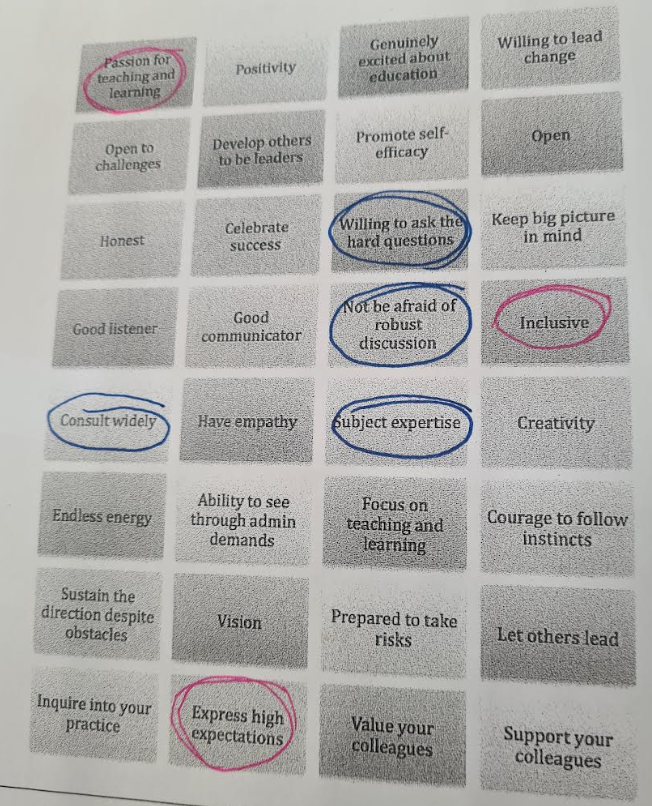
With your own situation in mind. Look below at the qualities of middle leadership

Select and write down 4 things that you do well and often as a middle leader and think of three that you would like to give more thought to.

Cultural Responsive Practice


What is the aim of culturally responsive practice?
Patara, 2012 P50
Relationships are key.
Purpose: Affirm or challenge what we do at school. 

Watched video of Brigham Riwai-Couch. Was hard watching the first time and is emotional watching it again...so I 
10 Ways to Teach Me
1) Have no other goal other than to teach me.
2) Have high expectations and believe I can and will achieve.
3) Don't underestimate the importance of pronouncing Māori words correctly.
4) Show whakawhanaungatanga - Relationships.
5) Honour the Treaty as the principles apply to education.
6) Don't kill my wairua, belittle me or put me down.
7) Design and deliver lessons to engage me. 
8) Use our culture and identity as an asset in the classroom.
9) Know that achieve is good, merit is better, excellence should be the target.
10) Understand that one size does not fit all.
Need teachers who try, and try and try again.


Learning From the Middle

Leadership needs to be distributed. 


Sunday, 3 March 2024

Māori Whānau Hui 2024

It has been a long time since we held a Māori Whānau Hui so it is great to be doing one this year. I am really looking forward to meeting with some of our whānau and hearing about what they want from us and how we can work together to get the best possible outcomes for our Māori students.

Wednesday, 7 February 2024

Māori and Our Values

Each of our school values has a Māori phrase that encapsulates the essence of the value. To encourage the use of these and the inclusion throughout the school, I added the relevant poster to each of our weekly values slides. 

I think it's an absolute waste of time and space if we don't keep our Māori kupu alive. Why bother having them there if nobody does anything with it. Tokenism at its best...but not for long.

I created the posters last year to try to encourage teachers to learn them and be able to share this learning with our tamariki.  This worked really well in our senior hub, Te Ara Angitu. Students were able to say what they were and what each part meant. The goal now is to have staff and students in all hubs using these kupu regularly and naturally. I'm looking forward to that.


Mihi Whakatau 2024

For the first time since being at Ara Tū Whakatā Gilberthorpe School, we added mihi whakatau to our school cultural responsive practice. My role in this was to support staff in knowing what would be taking place and what each part of the process was done for. I talked through what our whaikorero boys would or could say. 

I approached one whānau to see if they would like to be involved with some of the main roles, however they were unable so we have made a bit of a plan to get some support in learning how to do the karanga and whaikōrero. For this I am hoping to get some support to have a workshop or some kind. 

Another teacher and I performed the kaikaranga roles for this mihi whakatau and it would be awesome to build on this.


My next step: To support staff to become competent and confident in running mihi whakatau as an embedded and natural practice. 

Tuesday, 30 January 2024

Urū Mānuka Teacher Only Day 2023

Urū Mānuka Teacher Only Day 

Noema 2023

 Vision for Young People with Pene Abbie

Tumuaki Paparoa Street...not, she's moving on.

Game: Taco, Cat, Goat, Cheese, Pizza

Purpose: To become familiar with Te Mātaiaho. Discussion around Facebook page from the Ministry about  intentions for school and kura. 

1991 - Roll out of new curriculum documents. Were colour coded and teachers had activities where they used jigsaw puzzle type activties to learn about achievement objectives and content.

2002 - Stocktake of the curriculum introducing the nautilus symbol. Colours again respresent curriculum areas.

2007 - Lots of content in the front end and key competencies, values etc.

2021 - Decision to refresh what we had. Curriculum Refresh Time!! It is the time to do this and to keep tryng for our ākonga. See what is missing and fill the gaps. 
For us: Keep our learners at the centre!!


Photo Activity: We all had to bring a photo of a student in our class. I chose Mikayla. We shared why we chose them and although mine was because Joanne had some options for me, it was easy to talk about why I chose Mikayla, particularly about when she did the trust fall at camp and blew me away.

Key Messages and Challenges from Video: This video was about a group of rangatahi talking about their responses to the current curriculum and the vision they helped create for Te Mātaiaho.
Key points I heard:
  • Involve young people
  • Identity is embraced and accepted
  • The voice of young people being heard in order to affect change
  • Current one fits one type of person
  • Inclusive of additional needs and learners from out of mainstream
  • Te Tiriti of Waitangi and how we address and include.

For our young people and their whakapapa, how will they know their connections and what is our responsibility to make these available? 
This vision for young people is driving this refresh. How will this look? 
We, the ākonga of Aotearoa, know our world is connected, our wellbeing is collective, and that we have a shared responsibility to each other. This if for the ākonga. 
We understand our roles in giving effect to Te Tiriti o Waitangi and its principles. What is this like for a five year old?
We are strong in our identities, languages, cultures, beliefs, and values. This means we can confidently carry who we are wherever we go. Even if we are living overseas. 
We have a strong sense of belonging. This builds the foundation to be courageous, confident, compassionate, and curious. We understand that success can look different for us all. This means we can learn and grow from our experiences in a supportive environment.
We engage in learning that is meaningful to us and helps us in our lives. We can build and navigate knowledge, using our heads and our hearts to make our decisions. What does this look like to a 14 year old boy?
We are kaitiaki of our environment.
We acknowledge and appreciate our differences and diverse backgrounds and viewpoints. How does this look in different places.
We positively contribute to our communities, Aotearoa, and the world. 

Walk Around Activity - Pick two random people and move around the space. Keep them in your sight and walk around the room, forming an equilateral triangle. Meet and greet. Good to chat to other kaiako from different schools.

Group Task: Unpacking parts of the vision.
Put the photos of our kids on the big sheet of paper. Using one part of the vision, write three ways is plays out in your classroom. How will learners have this experience? Kahui ako level? What is next? 


Good ideas:
Bilingual Buddy Reading

Story Read: 


Connections:
Leonie HHS
L...Wigram


Presenting Maths with Kylie (MOE) and Megan Martin

Game: Head and Tails Statement about anxiety about maths starting before school, % of Year 9s who will be math literate, teacher trainees ability to teach Math at Year 7 & 8. (Incorrect heads or tail sits down). 

Literacy and Communication and Maths Strategy

Learners enter with different maths skills and experiences, experience bias and discrimination, (Missed the rest of her points...changed the slide too quick). 

Learning Areas of Te Mātataio

Q. What is Math? Understanding the world, puzzles, banking, numbers, problem solving, shopping. 

Whakatauki - Āno me he whare pūngawerewere Behold, it is like the web of a spider. Discussion: Strong anchor point to hold the web, progressions, not only one way to build a web, can be scary. 

Topics and tasks that reflect the identities and cultures of every student.

Changes:
Celebrates what is unique.

Supports ākonga to see themselves in their learning
Clear progreesions...notice , recognise, respond.
Anchors progression with outcomes. 

Understand: Big ideas that don't change.

Know: Contexts that you look at the big ideas through.


Task. In pairs, we had a series of questions to answer by looking through the 

Have a look at the progressions sheet in order to be able to see what should be happening at different year levels so you know what happens before your year level learning can happen. 
We looked at the following videos and discussed what we recognise from current practice and what opportunities we could see. 

 Ka Hikitia Ka Hapaitia with Emma Royal

Came from 2017 tour taking to the community within education to find what is working well for Māori, what needs improving and what next. Tau mai te Reo came from this as did many others. Tau mai te reo is the Māori Language strategy and has it's own mana, for supporting all ākonga in Aotearoa to flourish.
Ka Hikitia is the Māori Education strategy.
Guiding Principles
Excellent outcomes
Belonging
Strengths Based
Productive Partnerships
Te Tiriti o Waitangi
Discussion - What would we see if we saw Māori experiencing success as Māori. 
NELPS are same as objectives in Ka Hikitia. They are the same. 

1994 First deliberate Māori education strategy.

Outcome Domains:

Task: What are we already doing that is breathing life into Ka Hikitia:
Be deliberate about what we are doing. 

Action: To make mihi whakatau part of our school culture and also Māori whānau hui. Create a school haka and waiata.

Pasifika Education Plan with Jason Tiatia

Lead advisor for Pasifika education. 
Quiz: Action Plan for Pasifika is over arching, Tapasā  document. 

An introduction to Tapasā

Tapasā is a resource that provides a Pacific learner lens to Our Code, Our Standards | Ngā Tikanga Matatika, Ngā Paerewa.

Tapasā – Cultural competencies framework for teachers of Pacific learners
The Tapasā framework brings Pacific perspectives to effective and quality teaching practice at different stages of a teachers’ journey in key areas and transition points for Pacific learners in early learning, primary and secondary education.  

81,000 Pasifika students in primary through to secondary and is growing. 

There are 5 key shifts in the Education Plan. 

Talaono ako - is after school learning. Power Up was previous name. Is also a language app. 

Tongan is the second most spoken language in Oamaru.

Pacific students who preside in South Island is 9%.

Pacific Education funding is available to whānau, kura etc. 

Know your audience, know your students, know your whānau.

It takes four cups of tea before trust can be built.  Relationship is the number one thing to build trust. 

Fono = meeting

Talanoa = discussion


Key Shifts

Language - 

Confront Systemic Racism -

Enable Every Teacher -

Partner with Families - 

Grow, Retain and Value - 


Canterbury Primary Principal's Association presents...

 Middle Leaders Programme 2023

Somerfield School

Day One:

The day started with a welcome from the Year 6 rōpū.  All students do Kapa Haka as part of their performing arts programme.  (Two birds...well-played).  We then went through the characteristics of what middle leaders need to have and show.  
We then met our facilitator, Kellie who went through 

Self-Reflection on Your Leadership
Reflecting on your own practice helps develop you as a leader.
What do you believe leadership is?
I think it is a role that facilitates a team in order to grow in a variety of ways.
Who has influenced you as a leader?  How?
In my first years of teaching, Greer Doidge.  

What aspects of educational leadership do you think are the most important.
Self-awareness and emotional intelligence.  Relationships.  Vision.  

Qualities of leadership I do well:  
Passion for learning and learning -
Inclusive -
Express high expectations -

Qualities I want to develop:
Willing to ask hard questions - When things aren't quite going to plan, I need to get better at questioning in order to help the situation move forward.
Not be afraid of robust discussion - Not so much being afraid but more of being able to remain neutral and unaffected by responses if they are negative.  
Subject expertise - My main focus this year and into the future is to become more knowledgeable about all things Te Ao Māori.
Consult widely - I feel like I need to have more consultation with whānau and other leaders within a range of different schools.

Key points: When looking at my own leadership, think also about my circle of influence.  

School Leadership and Student Outcomes 
Best Evidence Synthesis Iteration (BES)


What is the aim of culturally responsive practice?
Question:  What does it mean to be Māori?  

In groups, we used some SOLO templates to discuss what 'giving effect' to Te Tiriti looks like and what going beyond honouring looks like.  
My thoughts:  As a Māori, I was interested to hear the thinking of those around me so kept pretty quiet.  
Poutama Reo - New resource to look at.  

Video of Brigham Riwai-Couch.  
A young man shares his kōrero with a message for teachers.  His 10 'commandments' for teachers are:


Tātaiako

In groups, we tried to match indicators to the competencies.  The list we had was from the Certified Teacher list.  This means all teachers should be doing these things.  

How will you build the mana for this student?  Our scenario was an overenthusiastic student disrupting Kapa Haka.  We filled in a table showing what we could do under wānanga, whanaungatanga, manaakitanga, tangata whenua, ako.  

Tātaiako / Culturally Responsive Practice
What are you personally going to do about this?  
Sharing this on Day Four of the course.

Current State: Currently in Level 3 of Te Ahu o Te Reo Māori course.  Some uncertainty around who has Māori heritage.

Actions to take: Daily revision of new learning.  Apply learning in class at school.  Survey whānau and create a database of who our Māori students actually are.  (Are we allowed to change the order of their ethnicities on Hero?)

Desired State - Goal to Achieve: To have school-wide knowledge of all our Māori students and the iwi they connect to.  

Leading from the Middle
In groups, we had a look at this document at the parts of the Leadership Model.  This helped us reflect on what is happening in our situation and what we could do.  We then used the indicators to plot ourselves along a continuum.  

Day Two:
  • What is Quality Teaching?
  • Educational Leaders Framework
  • Leading Change
  • Leadership Capability Action Plan
Talked about our Why...why did we get into teaching.

Activity - Sheets up on the wall with statements from BES Summary of evidence about quality teaching.
As a school, we looked at each list of evidence and noted down what we do.

UNDERSTAND.  KNOW.   DO.

1.  Quality teaching is focused on achieving high levels for heterogeneous groups of students on a range of valued student outcomes.
Learning pathways allow students to know what they are learning and what to learn next.  Tracking sheets.
2.  Pedagogical practices enable classes and other learning groupings to work as caring, inclusive, and cohesive learning communities.  
Values are taught every week and weaved throughout all that we do.  We also consider individual student needs around friends and people who will be supportive of them.
3. Links that facilitate learning are created between school and other cultural contexts in which students are socialised.
Learning pathways are shared with whānau and link to specific learning steps.
4. Quality teaching promotes student engagement with the instructional focus.
School-wide Inquiry initiative and structured literacy provide scaffolded learning.  
5. Quality teaching provides students with sufficient, high-quality opportunities to engage with instruction.  
Rewindable learning, Setting up for Success document is inclusive of routines and the classroom environment being a space to be set up for learning.  Expectation is to have an introduction lesson and a follow-up.
6. Quality teaching supports learning through a variety of instructional approaches.
Literacy and Numeracy programme expectations.
7. Quality teaching aligns curriculum goas, resources (including ICT), task design, and instructional strategies at both classroom and whole-school level.
Setting up for success document, tracking pathways, curriculum document expectations.
8. Pedagogy promotes learning orientation, student self-regualtion, metacognitive strategies, and thoughtful student disclosure.
Learning pathways.
9. Feedback and formative assessment processes further student engagement and success.
SMART goals are created and reviewed each term.  Learning pathways are shared.

For our next steps:  Choose an area that is linked to our annual plan so it aligns.  

Feedback and formative assessment processes promote further student engagement and success.

This involves teachers:
  • Having sufficient knowledge about curriculum content, pedagogy, and learners to be able to proc=vide constructive formative assessment; 
  • Providing students with regular, task-related, constructive feedback;
  • Particioating with students of clear learning goals;
  • Scaffolding students' learning so that they have a high probability of success;
  • Using feedback gained from student assessment as a basis for adapting their own teaching.

EDUCATIONAL LEADERSHIP CAPABILITY FRAMEWORK


Alignment with the Capabilities Chart:  The task was to start working on a table to identify what I currently do, not do or find challenging and what I want to develop.  Had to use the Framework when looking at this.  

Group Task Looked at 8 Dimensions

LEADING CHANGE
Change is about creating the new normal
Managing change is about using tools, systems and processes to control the effort and impact and impact on change
Leading change is about creating the motivation and momentum to see the change through
Create energy and use it effectively.  

Book Visible Learning for Teachers

Activity: Using the capabilities document, we used a table that focused on four of the capabilities, 1, 2 , 3 and 5.  This was actually quite a daunting task.  

One part of being a good leader is being organised.  

My area of influence is my team to influence student outcomes.  
Once a change has been embedded, it moves into the 'business as usual' folder.  Creating a new normal.  Middle leaders bring the power and momentum for the change.  Is it going effectively in the right direction.  If on tangents, guide gently back.  

Notes from Video clip Randy Pennington
Study from 20 years ago 70% of change efforts often fail.  Same stats now as then.  Change requires leaders to connect with people.  Change in leadership is essential if we want to see change.  
We change lightbulbs when they run out...which is when things go wrong.  Change can come from when we see opportunities to become better.  Crisis or vision?  Connect with people where they are 80% of what leaders talk about, doesn't matter to 80% of the people they are talking to.  
Use resistance as your friend.  Are they legitamletly concerned or afraid.  In leading change, you go first.  If people don't see you change, they have no motivation to follow and you have no credibility to make them want to follow.  
Have to learn how to change quickly.

Some change is mandated, such as the curriculum refresh.  

Conditions for an Effective Change
Along the change journey, we need to go back to the WHY?


Conditions for Change
  • Develop PLD
  • Clear roles
  • Update policies and procedures
  • Support transition to change
  • Remove or smooth barriers
  • Testing / trial / sandpit
  • Champions / role models
  • Resources and ways of doing it around here.
Reinforcement
  • Monitor the change and measure outcomes and impact of the change
  • Celebrate success
  • Build in short term wins
  • Reflect on the opportunities

People don't resist change.  The resist being changed.

Add second slide here

FOUR AREAS OF CAPABILITY FOCUS
Developing your Leadership Capability Acton Plan:
About shifting leadership practice.  Current and desired reality.