Tuesday, 30 January 2024

Structured Literacy PD - Writing

 Structured Literacy Learning - A Focus on Writing

With Jo, Lillian and Linda from Literacy Connections

Writing by hand is thinking on paper.
Thoughts grow into words, sentences and pictures.
Memories become stories. Ideas are transformed into
projects. Notes inspire insight. We write and
understand, learn, see and think - with the hand.

What we will be learning today:
Objectives: 
● How to enhance your writing instruction to improve your students writing, reading and comprehension ● To strengthen your understanding of two guiding writing models - the Not so Simple View of Writing and The Writing Rope 
● To provide practical examples and resources to implement directly into your education setting and bridge the gap between theory and practice.

Module #1 Laying the Foundation
Reflecting on what is happening in our school:
In our hubs, we brainstormed about what is happening in Writing in our space/school. We then had a look at the current data across Aotearoa.
A 2020 UNICEF report found that only 64.6% of 15-year-olds in Aotearoa New Zealand have basic proficiency in reading and maths. Turning that around, a staggering 35.4% – over a third of 15-year-olds – struggle to read and write. 

For us as teachers to teach students to write, we need to be able to write.
Key Resources:

I had a look at the book that was brought with our Literacy gurus and it looks like a really helpful book. One part I read was about handwriting, with one interesting section about what is lost when handwriting is neglected. (I need this book).

A reminder of the overarching Structured Literacy (SL) Principles 
● Direct and Explicit teaching - gradual release of responsibility 
● Cumulative- deliberate practice, reducing the cognitive load, constant review 
● Structured - follow a scope and sequence 
● Diagnostically - “go as slow as you must but as fast as you can”

It is important to have consistent terminology across the school.

Provide lots of opportunities for students to see, hear and do writing.

Key Principle 2 To boost teacher knowledge of what to teach and use a writing scope and sequence.
Keep in mind that the working memory can become overloaded.

Key Principle 3 Sentences are the building blocks of all writing and grammar is best taught in the context of student writing.

Key Principle 4 The content of the curriculum drives the rigour of the writing activities.

Key Principle 5 The importance of the planning and revising part of the Writing Process.

Key Principle 6 The importance of regular feedback, writing goals and assessing student writing.

Key Principle 7 Embed the teaching of writing through all subject areas and in the content of the curriculum you are teaching.
We need to be teaching writing throughout all areas, not just in writing time. 

Module #2 Transcription Skills
Handwriting
We rated the importance of handwriting on a scale from 1-5. I rated it as 5. 
 Is handwriting taught in your classroom? If so, how often?
Yes. Twice a week for whole class lessons.
Short and sharp handwriting lessons daily.
 Do you use a handwriting programme or a scope and sequence?
Not really. Tried to teach Casey Caterpillar.
Will continue to use Casey Caterpillar but do it better and align with our school-wide programme.
 Is handwriting an independent/whole class activity?
Taught as whole class but done independently.
S
Do students have a handwriting book? How is this used?
Yes. Had dotted line to teach where letters are meant to be and how they are formed. Also, other areas of the curriculum are integrated like values quotes, Te Reo Māori.
 Are there consistent expectations for handwriting across the school?
We try to all use Casey Caterpillar.
What tools are used e.g. pens, pencils, chalk etc?
Pencils and books at desks. Children can view model through learning site.
 Where do students practice handwriting?
During handwriting lessons and when doing other learning in different curriculum areas. 
Is cursive handwriting taught? If so when?
Not so much.
Is there an emphasis on pencil grip, posture etc?
Yes. It has been very difficult to change habits at the senior level.

Research shows that a lot of teachers have not had the teaching of Handwriting. 
Activity: We had to write about our day yesterday using our non dominant hand and in cursive writing. We then had the opportunity to use our dominant hand. When reflecting, we realised the coginitive load that some students have.


Human beings can't think of too many things at once. Capacity limit. Too much information to hold on to.  Capacity is freed up through automaticity. So many skills involved because some skills are not automated. If you struggle with the basics of handwriting, you struggle with writing.
Handwriting fluency exam: With an intervention, all students who struggled, were able to improve accuracy and also expression.
Drill and kill...it works. Frequency is more important than quantity. Go back and ficus on sub skills. 

What do we know about poor transcription skills? 
Teaching Handwriting
The mechanics 
● Posture 
● Paper position 
● Pencil grip 
● Letter formation and motor movement 
● Automaticity 

I am left eyed dominant and right handed. (Note: We don't need to check students but be aware of how they position their writing). 

Bulldog clip is a good option. Mechanical pencil for those who have a heavy hand. Using a pen or pencil is up to the individual child, depending on their needs. Lame range of pencils/pens. 
He pātai tāku...what about lines in books. 
Write in different ways including chalk, large movements.

Letter Formation - A Scope and Sequence
Letter Formation 
● Clear, consistent language modelled 
● Follow a scope and sequence - teach similar shapes/strokes together 
● Correct starting position 
● Immediate corrective feedback given 
● Say the letter name while writing, sound when writing/spelling words.
Monitor as students are writing so corrections can be made. For us in Angitu, we will need all staff to roam.

Automaticity 
● Automatised handwriting significantly improves both the quantity and quality of writing (Berninger 2012; Graham, 2009-10) 
● “Legibility without speed is an aesthetic art form; speed without legibility is a useless tool.” (Marcus, 1977 )

Casey Caterpillar is junior focused. Can be a cognitive load. Can adapt the story side of things for seniors. 

Video: Handwriting lesson with a student who has disgraphia and learning delays. In the video, teacher says the verbal prompt for each letter and the student repeats it. Feedback given to fix mistakes. For seniors, writing assessment a to z. Give a set amount of time and see how many children can write. Check to see which letters we are struggling with. Do multiple letters of the same verbal prompt such as open mouth short stick, open mouth tall stick. 
He pātai tāku...what paper do each hub use?
I DO.   WE DO.    YOU DO.   


What about typing/keyboarding? 
Students could write faster and produce larger quantities of writing under the keyboarding mode ie students produced more typed words than handwritten ones within the same period of time (Fing, Lindner, Ryan Ji & Joshi 2017) Students with higher handwriting fluency tend to have higher keyboarding fluency (Fing, Lindner, Ryan Ji & Joshi 2017) Mueller and Oppenheimer 2014 found that when students typed notes, they tended to write verbatim rather than processing information and rewording it under the handwriting condition. They wrote almost 3 times more notes, however, achievement was not significantly promoted.

Explicitly teach both handwriting and keyboarding. Don’t choose one in favour of the other. Keyboarding could become an independent activity during your reading rotation: https://www.typingclub.com Supporting students with severe handwriting issues: exhaust all reasonable attempts at handwriting instruction before foregoing it in favour of full reliance on assistive technology for transcription. Encourage struggling students to hand-write spelling words and use keyboarding for story writing.

Looking at our brainstorm
Number formation needs to be done Math time. Start on whiteboards. 

Next Steps Look at your brainstorm…. 
● Identify what you will continue to do. 
● One thing that you will adapt. 
● One thing you will stop doing. 
● One thing you will further research or experiment with.

Can continue using pencil control and fine motor skills development as a supplement rather tahn replacement. 

MODULE THREE: Text Generation: sentence level

The things that you have to have in order to be able to do the text generation part of the rope. 
PARTS OF SPEECH:
noun -
abstract noun - 
proper noun - 
pronoun - 
adjective - describes a noun
article - definite and indefinite the a /some
verb - action
adverb - adds to a verb
preposition - on / next / below
conjunction - joins, because / so
interjection - Gosh!! Wow!

SENTENCE COMPONENTS


A sentence needs to have a subject and a predicate. Needs a who and a do
Independent clauses can stand on their own as we have all of the information. 
Dependent ones need more information.

SENTENCE TYPES
Simple Sentence: is made up of one independent clause I 
John threw the ball. 
The chef at the deli makes the best sandwiches. 
Andrea put her books in the car and then texted her friend.


Let's try it:


Use the terms and language and students will follow.
SYNTAX - How a sentence goes together and make sense.
From The Writing Revolution, there are a range of activities that we can use in our explicit teaching.
Sentence level activities:
Always model first, being direct and explicit. Have student s do oral activities prior to writing. If we can say it, we can write it. Make sure you have the dictated sentence ready prior to the lessons. You need to check that it works. Keep practicing the activities. Activities should be used recursively...that means coming back to it. 
When scaffolding, you could have the who (Subject) shown and students can pick a do (predicate) part. 
Use F and S to identify if things are a subject or predicate. Can repair fragments. 
You could have a text on the board as children arrive to school and they can look for fragments and fix them.
Be mindful of commands as they don't have a subject...ones like 'be quiet', 'sit down' etc.


Teacher Tips:
Model thought process for students 
Provide opportunities for deliberate practice. 
Plan instruction and differentiate lesson for those that need it. 
Avoid long texts 
Avoid using unknown content or vocabulary.

Statement.     Question.   Exclamation.   Command.
Start with identifying the types of sentences. Next step, add punctuation.   Use the word repair when we are talking about fixing sentences. 
Give some expectations and criteria about the level of sentences that you expect depending on the level of students. 

Include given vocabulary and write a sentence.
Take it off the page for kinesthetic learners.
Punctuation fans can be used as a hands on support.

Scope and Sequence
See in shared folder and also the Grammar Project

My Goals:
  1. I'm going to upskill and review and revise the content


Wednesday, 15 March 2023

Mathletics Learning

 Mathletics Tutorial


My level of knowledge and skill in using the Mathletics dashboard hasn't been very good for the past year.  I have started accessing the support. materials and webinars to upskill and ensure I am using this platform effectively to support student learning.


Monday, 13 March 2023

Te Ahu o Te Reo Māori

 Level 3

In 2022 I reignited my Te Reo Māori learning journey by starting Te Reo Māori classes through the Te Ahu o Te Reo Māori o Ngāi Tahu classes.  In Terms one and two, I did Level one which was online.  I continued in the second semester doing Level 2.  

In 2023, I am doing the Level 3 course which is certainly up a few notches for me.  My goal this year is to be competent at Level 3, even if I have to repeat the classes in the second semester which is quite likely as I don't feel confident enough to be doing Level 4.  We'll see how it goes though.  

This semester I have actually started doing the mahi kāika that has been set and doing some study through the weekly kupu lists on Quizlet.  I aim to use Quizlet every day to build my vocabulary and so far, I have reached a seven-day streak.  

I was happy to be in the top three for our in-class Quizlet.
Quizlet has a matching activity in it that times you and ranks you against other learners.  This has been a great tool for my learning and challenging myself to get a quicker time.  

Our mahi kāika sentences to translate.

My mahi kāika for one week.  A couple of errors with a and o categories.


Saturday, 11 March 2023

Learning to Use Google Drawings

 Our Digital Learning Journey

This year we have many new tamariki to our hub who have limited knowledge and skills when using Google Apps for Education.  This week we did some digital technology work integrated with our values focus.  

We modelled how to create a Google Drawing inside a folder in our drive.  We then went through how to insert text boxes, change sizes, background and filling a space with colour.  

Instructions and steps were written in the comment section and students who had been in our hub last year were used as experts. 

Next steps:  From looking at the quality of work produced, it is obvious that we need to do some more scaffolding, modelling and refreshing of what has been done so far.


Thursday, 9 March 2023

Manaiakalani Toolkits

 Level Up on Autism


For our Term One Toolkits through the Manaiakalani Outreach Programme, I registered for the Level Up on Autism session hosted by Natasha Olsen.  I thought this would be helpful for me as I currently have some students who are on the Autism Spectrum and present with a range of specific needs and characteristics.  

Although the sound on the Meet wasn't working, I spent some time looking through the slide that was shared and the speaker notes which were really helpful. 

I think I am at the 'acceptance' level on the Level Up Scale.

The estimated population of people with ASD in NZ is approx 50,000-100,000 (1-2%).

An autistic person may have difficulties with social communication and social interaction skills. This means that a person with autism might have difficulties reciprocating in conversations and social interactions, engaging in nonverbal behaviours (e.g., eye contact, gestures), and developing, maintaining and understanding relationships.

People with autism may also demonstrate restrictive, repetitive patterns of behaviours, interests, or activities. This might include an insistence on sameness (e.g., rigid, black-and-white thinking, difficulties with change) or engaging in behaviours that may be perceived as unusual. Sometimes, a person with autism might also show intense focus on objects or interests and possess sensory sensitivities (e.g., hyper- or hypo-sensitive to sights, smells, touch, tastes, and sounds).

Executive functioning

Executive functioning is a set of mental skills controlled by the frontal lobe of the brain. It affects our ability in two key areas – organisation and self-regulation. People with autism often have problems organising, prioritising, problem-solving, accessing working memory, thinking flexibly and self-monitoring, eg, difficulty following more than one instruction.

Strategies:

  • Use routines

  • Use visual support to aid organisation

  • Routine and predictability mean safety for someone with Autism

  • Give one instruction at a time 

  • Plan for transitions

  • Understand children's signs of stress or anxiety

  • Teach children strategies they can use themselves

  • Make consequences clear. Explicitly lay them out

Anxiety

75% of children and 50% of adults with ASD experience intense anxiety.

Anxiety is an intense and often overwhelming feeling of worry, nervousness, or unease about something with an uncertain outcome. It also has varying physical effects on our bodies, such as increased heart rate and sweaty palms. Often it results in people avoiding situations, preferring sameness, rigid thinking, social withdrawal, repetitive movements or noises, and sometimes anger or meltdowns.

Many autistic children meet the criteria for an anxiety disorder. For those who don’t, anxiety is still a common experience in their everyday lives and can make it difficult to make friends, focus at school or complete daily tasks as it can show as being ‘difficult’.

Strategies for anxiety:

  • Identity key stressors - environment etc

  • quiet/low stimulation spaces available

  • Keep your voice calm

  • Teach self-calming strategies

  • Build on strengths

  • Limit choices

  • Break cards

  • Sensory box

Communication

Communication is a shared experience in joint attention and this is a common challenge for the neurodiverse brain.  

Strategies:

  • Make sure you have the child's attention

  • Avoid complicated instructions

  • Keep up your language polite, clear and factual without being patronising

  • Allow the child enough time to process

  • Supplement verbal instruction with visual information

  • Try to have important conversations in a quiet area

My next step is to attend the Term Two toolkit which will look specifically at interventions in the classroom that can increase engagement and help create an environment that best suits our learners.

Wednesday, 22 February 2023

Getting Our Gmail On

Teaching to Email 

This year, many of our learners are not yet familiar with using Chromebooks and Google For Education so we are needing to teach some basic skills in order for our tamariki to become confident and capable in using Google For Education tools to enhance their learning.

Today it was time to introduce students to their school email accounts.  We use emails mainly for sharing, communicating and refining writing, reading and spelling skills.  

We showed students how to access their accounts, how their Gmail inbox is set out and how to compose an email.  Our focus was on finding someone's email address, where to find the compose icon, what to include in the subject line and how to start an email.

Students were shown how to access addresses for the two teachers and one teacher aide in our hub.  Students then had time to write emails with the subject based on testing emails to each of our hub staff.  

We touched on how to clear emails from the promotions and irrelevant messages that come through and will have another session to make sure inboxes are clear, organised and relevant to learning.  When we do this task, we will also teach students how to unsubscribe to junk.  

Tonight, our staff had some mahi kāika to reply to emails while checking to see what student's next steps might be such as using capital letters for the subject line and starting sentences.  This has lots of teachable moments and also gives us an opportunity to connect and put smiles on our faces.

So tonight, my inbox looks like this:

One of our email conversations:


Tips For Writing

 Learning to Write - It's Time to Change How We Teach


I came across this blog post through an Essential Resources product promotion email.  It's particularly interesting for me as this year's target group in my hub is a group of Year 6 writers who are not achieving at the expected level for their year group yet.
Five simple, yet effective tips for teaching and inspiring writing.  
I have copied and pasted the whole blog so I can access it in the future.  

Why prioritise learning to write?

Writing instruction contributes to the development of a wide range of skills and attributes. Teaching handwriting helps to secure letter knowledge in long-term memory; teaching spelling enhances decoding skill; and writing about what we read improves memory and comprehension.

More profoundly, writing has long been acknowledged as a tool for thinking, in that when writing we articulate reasoned arguments and gain opportunities for creativity and self-expression.

Learning to write – the ongoing influence of process writing

Given the importance of learning to write, low rates of achievement in many countries are cause for concern. A contributing factor appears to be the continuing influence of process writing – Donald Graves’ approach to teaching writing that was influential during the 1970s and 1980s, despite a lack of empirical evidence to support it. While the term ‘process writing’ has now fallen out of favour with classroom teachers, research suggests that use of some of Graves’ methods is still widespread.

Here I present five such methods for learning to write – common in many classrooms – that limit student progress in writing. For each of these methods, I also present an evidence-based alternative. Practising this suite of small changes could positively transform student achievement in writing at your school.

Change 1: Swap out personal recounts for more interesting topics

Graves told teachers that personal experiences were the best inspiration for writing. Yet this kind of writing encourages an unsophisticated ‘recall and write’ process, and often results in a boring story.

Instead, set tasks that relate to the big, wide world: reports about dinosaurs, volcanoes, apex predators or the solar system; narratives set under the sea, in a dark forest or among ancient ruins. Plan these tasks carefully. For non-fiction topics, integrate writing with other curriculum areas so that students work with the knowledge before writing about it. For narratives, prepare your model carefully and consider the challenges your students will face as they come to write their own.

Change 2: Instead of a free-flow drafting process, teach your students to read and check every sentence as they write

Graves told us that writing was a staged process: plan, then draft, then edit and finally publish. As part of this process, the first draft happens in a ‘free flow’ way.

In contrast, empirical researchers have described the writing process as a ‘juggling act’. Skilled writers plan and modify their planning, even as they come to write their final paragraph. They re-read and revise throughout the drafting process – from the very first sentence. This continual checking and refining increases self-awareness, which leads to higher-quality writing for both surface and deeper features.

So, instead of encouraging free-flow drafting, we must teach students to think of a sentence, write it and check it immediately, asking questions such as: Does it sound the way I want it to sound? Does it have a capital letter at the beginning and a full stop at the end?

Change 3: Prioritise technical skills in the early years and teach them explicitly, every day

Theorists such as Graves de-emphasised the importance of teaching handwriting and spelling, telling teachers to instead prioritise the expressive aspects of writing.

However, numerous empirical studies have shown that if a student does not master the technical skills, implementing them will occupy all of the student’s working memory and make it impossible for them to focus on anything else (including the ideas they wish to express).

So teach handwriting and spelling every day. Teach these skills explicitly and closely monitor your students as they practise. This will have massive pay-offs for writing achievement and motivation, and will support reading development too.

Change 4: Instead of invented spelling, use co-constructed spelling

In many classrooms, when students ask how to spell a word, the teacher tells them to listen to the sounds and write what they think. And while it’s true that listening to sounds is a good starting point for spelling, what happens if a student doesn’t have the knowledge to record those sounds? At best, this approach leads them to record an incorrect approximation. At worst, it’s a killer for motivation, as the student sits anxiously, reluctant to try in case they make a mistake.

A much better option is to use co-constructed spelling. When students ask you how to spell a word, support them to segment the word into sounds, prompt them to apply their existing knowledge of sound–letter correspondences and then show them the rest of the word.

Change 5: Teach students to use erasers, rather than crossing out, to make tidy corrections as they write

Graves told us to have students cross out errors instead of erasing, supposedly to keep up the ‘flow’ of the first draft. However, skilled writing is not free-flow writing – checking and correcting are important skills in the writing process. Unfortunately, crossing out makes checking difficult as the page becomes cluttered, messy and difficult to read. This practice can also be a problem for motivation as many children want a tidy page and feel self-conscious about sharing writing when all their errors are still visible.

So teachers, it’s time to bring back the eraser. Keep one in your pocket for the first few months of the year and give students their own when they are ready.

Make these changes and students will love learning to write

Process writing practices are so pervasive that teachers and leaders often take them for granted, failing to consider other options. But rates of student achievement are at an all-time low, and many students are reluctant to write at all. Have a go with these suggested changes and watch your students thrive. Teaching writing will feel exciting, and writing lessons will become a highlight of every school day.

About the author

Dr Helen Walls is a professional learning facilitator and educational researcher, with 20 years’ experience working in schools. She is committed to raising achievement in writing by sharing evidence-based, practical methods to engage every student. Helen is managing director of The Writing Teacher, a consultancy that provides writing workshops and resources for teachers, all accessible online. She is also a member of the Massey University school support team. For her PhD thesis, Helen conducted two empirical studies into the teaching of writing, which included a trial of the Fast Feedback Formative Evaluation System outlined in this book. She has published with The Australian Journal of Learning Difficulties and The Education Hub

Friday, 17 February 2023

Learning With Google

 The Art of Designing Digital Lessons

February 2023


After what feels like a very long time, I have just had a great session of learning about new tools within Google for Education that excite and intrigue me.

Last year my teaching partner and I signed up for some Google learning but then found that it clashed each week with other commitments so we didn't engage. Tonight, I received an email with links to a recording of the new Learn With Google monthly webinar for 2023.

I watched the recording and very quickly found myself excited and mind-blown by the amazing range of tools that Google has available. I now have a refreshed interest in developing my learning further and will be using these webinars to further my learning.


The slide deck that was shared has a page with four '15 Tips in 15 Minutes' which has already expanded my knowledge and ability to use Google Drive and Google Docs in more interesting and effective ways. I even added emojis to some folder names.


I had already made a personal and professional goal to be better at teaching and including digital technology into our classroom and unintentionally have found the perfect format for me to become more capable in doing this.
To start the year I have already posted some in-class learning to our hub blog and after a year of being incredibly slack in using my professional blog, am happy to be creating this blog post to start 2023.

Thursday, 26 May 2022

iDeal Syllable Division

 iDeal Syllable Division

Effective Strategies for Teaching how to Read and Spell Multisyllabic Words

Presented by Learning Matters Ltd

Today we are viewing a webinar to support our learning in Structured Literacy.  

Since reading is not a natural process, literacy must be taught through the lens of the science of reading.

Elements of Structured Literacy

Phonology

Sound to Symbol Instruction

Syllable instruction

Syntax

Morphology

Semantics

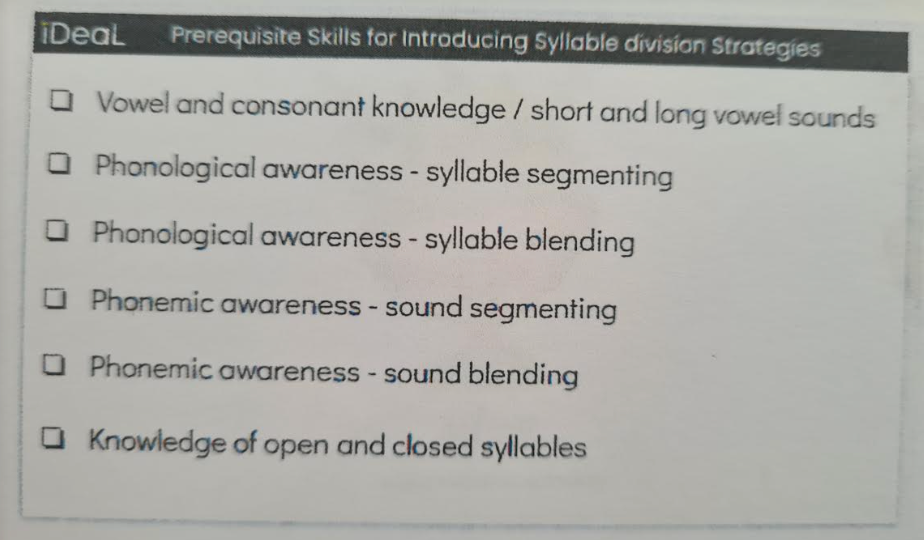
Students need to know 

Syllables are made up of sounds (phonemes)

Automaticity of symbol to sound

The different syllable types in the word.

To Spell a word, the child needs to know:

  • How to segment the whole word into syllables (away from print)
  • How to segment each syllable into sounds (fingerspelling)
  • Which written letter corresponds with that sound
  • Automatically, how to form the letter that corresponds with that sound.
See the Learning matters site for Syllable Types Poster


Clap while saying each syllable.  Can use pictures so sound awareness is intact.  
Webinar Takeaway:  Checking the understanding of what children know about syllables.  Is a good way to start and know what you will teach.


Make no assumptions about what children know about reading, writing and spelling.  

Short and Long Vowels
Before using the language of short and long sounds, teach open and closed syllables. Short because a consonant closes the vowel in.  When we remove the consonant, it opens the vowel sound.  

Closed Syllables
Once we understand short vowel sounds, we want them to know how to read CVC words.

Open Syllables
Takes one vowel to produce the one vowel sound. Use roll the dice and read.  

Identify the first vowel, split through the middle and blend.  Identify vowels and consonants.  Where might the syllable break go?  
Underline the vowels with your eyes, where are the consonants?  

Syllable division is taught through a scope and sequence.  

Silent e Syllable
Contains a long vowel sound produced by a silent e that sits at the end of the syllable.  

(Have a look at the GoNoodle syllable clip).

When teaching syllable types, it's essential for classes to be using the same language.  Use silent e as it's linguistically correct as far as terminology goes.  
Use no, not and note to help teach syllable rules.  V/CV

Oral Language helps to build a phonological lexicon.  donate V/CV do/nate.  Clap the sounds prior to dividing syllables.  Don't encourage children to look for words within words as this can cause confusion.

VC/V Third Strategy or Flex Rule
Draw on prior knowledge to see which words sounds right and teach the vocab.  h a b /  i t. Syllable types closed and closed??  leg / ume closed and silent e. vol / ume closed and silent e.  We are teaching to read and spell.  Spelling, hearing and re-reading the word help for it to become orthographically mapped.

Consonant le -final Syllables
When a word ends in a consonant and l e, count back three. 
When reading, what we read we write, when we write, we read.  Consonant l and e, go back 3.  Make sure you don't get the c le confused with a suffix.
Schwa Vowel Sound
Like colostrum.  One of the most common vowel sounds.  Use knowledge of open and closed syllables and three syllable division.  

Schwa can represent any vowel sound.  
A schwa is a vowel sound in an unstressed syllable, where a vowel does not make its long or short vowel sound. It usually sounds like the short /u/ sound, but is softer and weaker. The schwa sound is the most common vowel sound (and the only speech sound with its own special name). Examples of a schwa: a: balloon.
Comes at the end of a word but can also be in the middle of multisyllabic words.

Remember that New Zealand English is quite casual.
matter...sounds like a which makes that sound a schwa sound.

Syllable Types Require Explicit Teaching using a Cummulative Scope and Sequence
Teach all the same types of words together so cognitive load is removed from the child.  

We need to spend more time ensuring students are fluent at word level reading.  

What is reading fluency?  
  1. Accuracy
  2. Rate
  3. Phrasing - Prosody - Expression
  4. 1.
    the patterns of rhythm and sound used in poetry.
    "the translator is not obliged to reproduce the prosody of the original"
  5. 2.
    the patterns of stress and intonation in a language.
    "the salience of prosody in child language acquisition"
  1. Have students read a seen text
  2. Time them for 1 minute
  3. Count how many words they read
  4. Deduct errors
  5. Determine words per minute and consider this in relation to norms.
Reading in Connected Text and Spelling
Consonant le not to be confused for suffixes
e.g. ible meaning able to
With knowledge of suffixes you can offer extension.  

Taking the Strategy to Spelling
  • Saying the whole word.
  • Say the word and clap syllables.
  • Say the first syllable then fingerspell as this is taken to print.
  • Say the second syllable then fingerspell as this is taken to print.
  • have the student read the word back as you mark it.